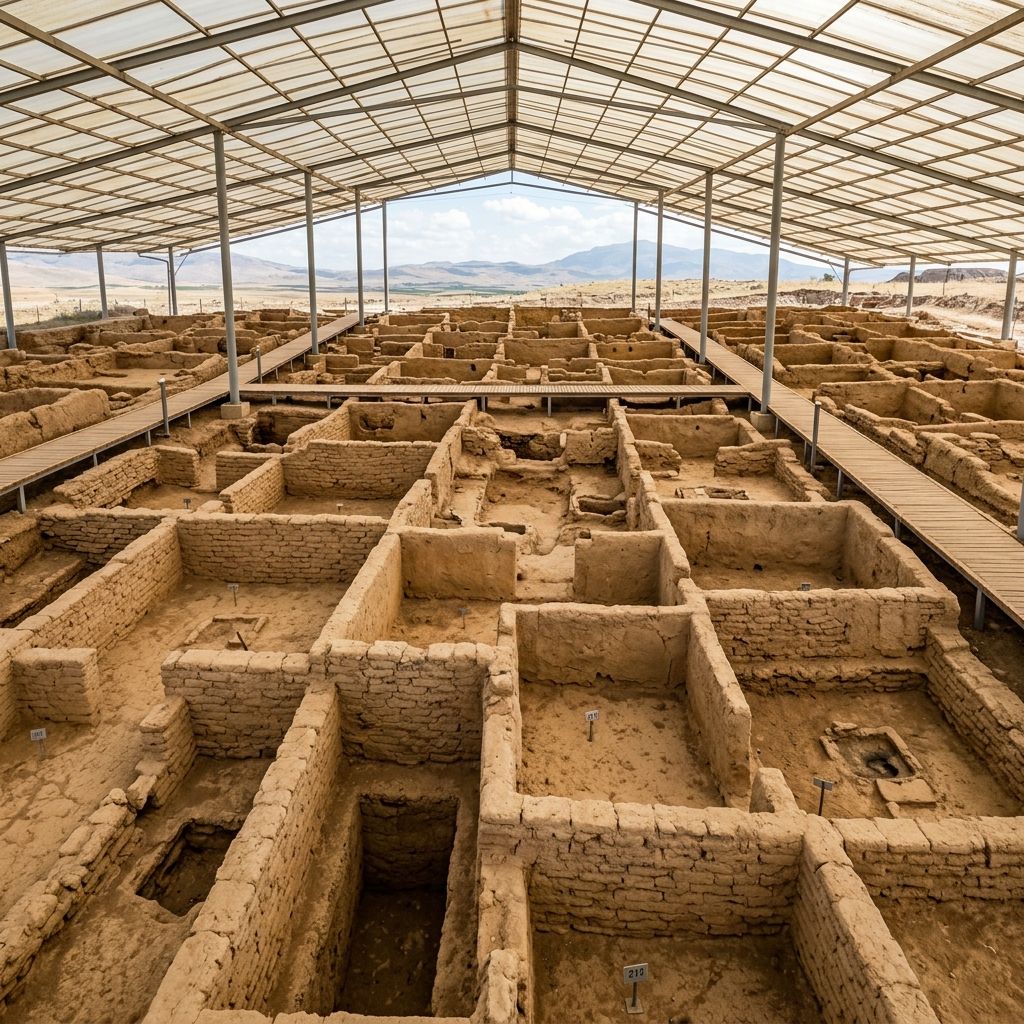
Çatalhöyük. We’re talking about a place within the borders of Konya that no one knew about until 1958. Even its name was given later. Because it lies below the level of the plain, it has been remarkably well preserved to this day.
It came to light on November 10, 1958, when British archaeologist James Mellaart discovered it. Obsidian and burnt wall finds caught his attention. The excavation began in 1961 and lasted 4 seasons.
In 1965, the excavation permit was revoked on suspicion of antiquities smuggling; the site lay idle until Ian Hodder arrived in 1993.
Today the excavations continue under the leadership of Anadolu University.
Çatalhöyük is not the world’s first known settlement; Jericho is older.
It is not the first monument; Göbekli Tepe is older.
It is not the first village; nearby Canhasan was founded 750 years before it.
Çatalhöyük is the first known city. Around 8 thousand people lived here.
Between 7,400 and 6,200 BC, it was built in 18 layers, one on top of another, and lasted about 2,000 years.
On the walls there are hunting scenes, extinct wild animals, leopards and paintings of vultures. According to their beliefs, the dead were left out in the open so that vultures would strip their flesh.
The world’s first map is here too: The peak of Mount Hasan with a bird’s-eye view of a city plan in front of it was found. You can see it at the Museum of Anatolian Civilizations in Ankara.
The people of this period were producers; they farmed, herded sheep, and made bread and porridge. Produce was stored in each house’s own storeroom. In other words, the city was built not as a colony but on an individual structure.
The houses, built wall to wall, were entered through the roof. Below the entrance were an oven and a hearth. Food was cooked, the room was heated, and the smoke went out through the same hole. That’s why the houses were very sooty. Research suggests that this soot shortened people’s lives and caused early death. Soot deposits on the ribs of skeletons support this thesis.
Even though this was the Neolithic period, there was a serious sense of cleanliness. Some rooms were replastered 450 times, layer upon layer.
So far only 6 percent of the city has been excavated. Thousands of structures are still underground. The outermost houses have no windows; their walls served as a natural rampart against wild animals and floods. No temple or palace-like structure has been found yet. According to the data we have, we see an equal people and free households. In other words, the city was founded on equality.
I also looked into Çatalhöyük’s connection with Göbekli Tepe but couldn’t find direct evidence of kinship. We see common symbols in both periods: the vulture, the bull, wild animals. But that’s not enough. Who knows, perhaps a link will emerge as the excavations go deeper.
In the 7th millennium BC, under the pressure of climate, disease and social breakdown, the city was abandoned, its population scattered, and they carried settled farming westward. Since there are no written records, we don’t know exactly how it happened. But we can say that Europe’s first farmers are the descendants of these people.
Although visitor numbers rose noticeably in the first years after it joined the UNESCO list, it receives far fewer visitors than Göbekli Tepe.
Yet there is so much to tell.
Here’s hoping it one day gets the recognition it deserves.
Sources
- UNESCO World Heritage Centre, “Neolithic Site of Çatalhöyük”. Open source
- Wikipedia, “Çatalhöyük”. Open source
- J. Mellaart, “Excavations at Çatal Hüyük: First Preliminary Report, 1961”, Anatolian Studies, 1962. Open source
- Çatalhöyük Research Project, “History of the Excavations”. Open source
- Wikipedia, “James Mellaart”. Open source
- Çatalhöyük Araştırma Projesi, “Çatalhöyük Rehber Kitabı” (Türkçe). Open source
- Çatalhöyük Research Project, “Çatalhöyük 1996 Archive Report – Human Remains”, 1996. Open source
- Hürriyet Daily News, “New neighborhood found in Çatalhöyük”, 15 Temmuz 2021. Open source
- Smithsonian Magazine, “These Stone Age Murals Might Be the Oldest Maps Ever”, 2014. Open source
- Arkeonews, “One of the world’s oldest streets unearthed at Canhasan 3 in Türkiye, dating back 9,750 years”. Open source