It belongs to the Venetian Doge Enrico Dandolo, who plundered the city at the age of 93.
In 1204, Dandolo, the financier and secret director of the Fourth Crusade planned for Jerusalem, diverted its course to Istanbul. This meant that this Christian city was plundered by Christians for the first time. Sacred relics and gold, above all from Hagia Sophia, were torn from their places and shipped to Venice.
Istanbul never returned to its former glory after this attack. Even the four bronze horses known as the “Triumphal Quadriga,” displayed today in St. Mark’s Basilica in Venice, were ripped from the monumental entrance gate of the Hippodrome and carried off. Dandolo died one year after the occupation; his only wish was to be buried in Hagia Sophia, and they carried out his will.
Hagia Sophia means Holy Wisdom, and the building standing today is the third Hagia Sophia built on the same site:
When Constantine made the city the capital in 331, he began the first construction on the spot where Hagia Sophia stands today; it was completed in 360. It burned to ashes in a fire.
Emperor Theodosius II built the second Hagia Sophia on the same site in 415. This structure was destroyed during the Nika Revolt of 532. That revolt broke out in the Hippodrome against Justinian and the taxes he had raised; the gathered crowd was put to the sword by heavily armored troops under the command of his general Belisarius. It is claimed that more than thirty thousand people were killed. During this uprising, the second Hagia Sophia also burned to ashes. Remains of this structure are still in the garden today.
Justinian decided to build the most magnificent, largest structure in the world. Instead of architects, he worked with scientists: the mathematicians Isidore and Anthemius. They applied extraordinary construction techniques; the idea of building a dome on top of two half-domes was a first in history. With radical solutions such as self-healing mortar and exceptionally light bricks, today’s Hagia Sophia came into being.
At its inauguration in 537, he is said to have exclaimed, “O Solomon, I have surpassed you!”
And indeed, it went down in history as the largest building in the world for about a thousand years.
The final signature on Hagia Sophia, built hastily and with errors, was put by Mimar Sinan. Noticing, as the building was on the verge of collapse, that the dome had turned elliptical because of a miscalculation, Sinan supported the building with 8 buttresses and gave the dome back its circular shape. Thanks to this restoration, Hagia Sophia has survived to our day.
There are 8 more Hagia Sophias in Türkiye.
The name is not unique to Istanbul: dedicating churches to ‘Holy Wisdom’ was a common Byzantine tradition, and giving this name to a city’s main church symbolically tied that city to the imperial center.
Hagia Sophia, which had welcomed visitors as a museum, was reopened for worship six years ago around this time of year. With 6–7 million visitors a year, it is still one of the most visited religious buildings in the world.
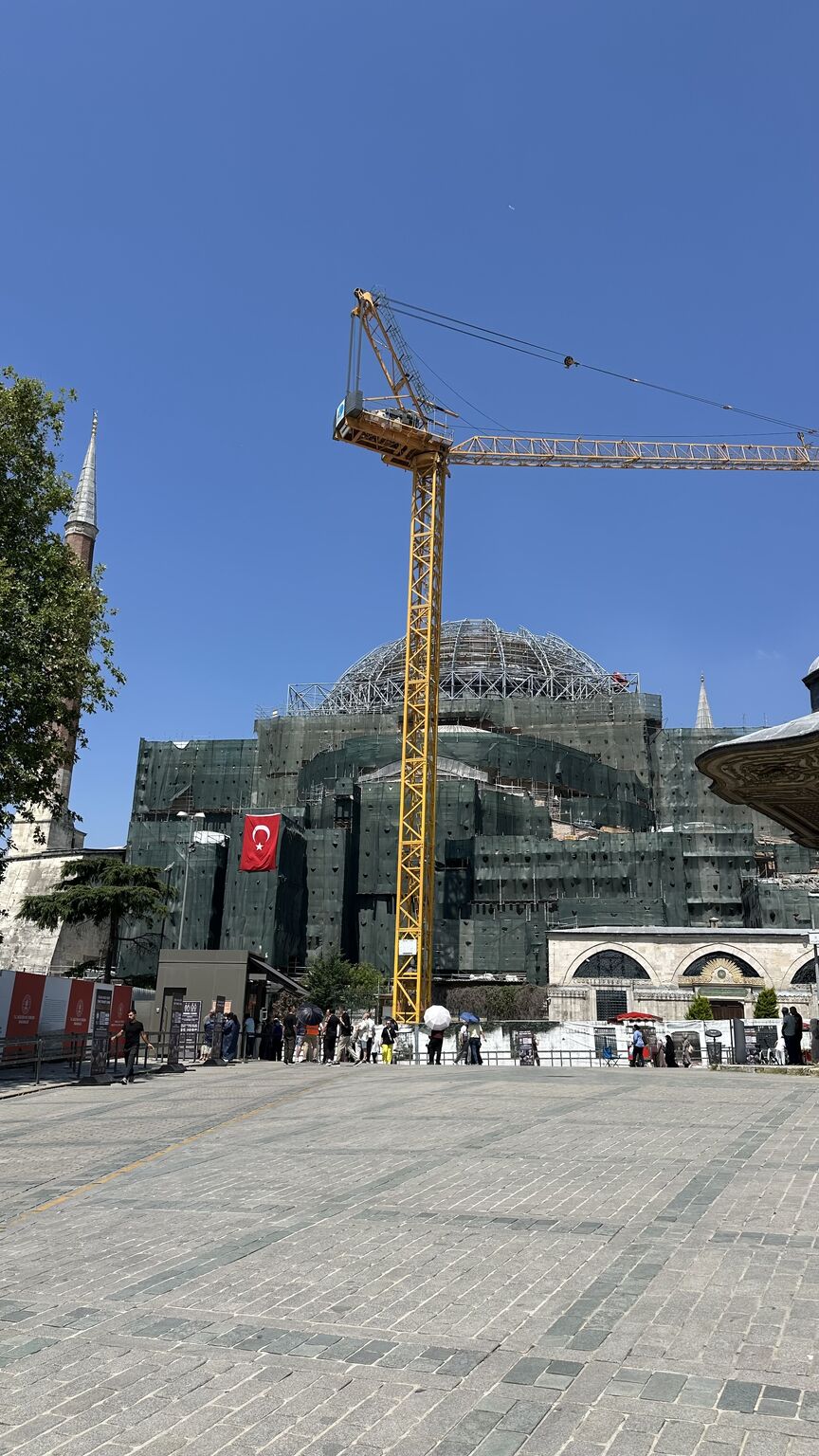
Today it is undergoing an extensive restoration, from its dome to its minarets. With this restoration, closely followed by UNESCO as well, Hagia Sophia will be safely handed down to future generations.
I end this piece with a historical irony: The loot is in Venice, while the man who had it plundered is still inside Hagia Sophia.
Sources
- Wikipedia, “Enrico Dandolo”. Open source
- Wikipedia, “Hagia Sophia”. Open source
- TDV İslâm Ansiklopedisi, “Ayasofya”. Open source
- Wikipedia, “Horses of Saint Mark”. Open source
- Wikipedia, “Nika riots”. Open source
- TRT World, “How the Ottoman architect Sinan helped Hagia Sophia survive for centuries”. Open source
- TRT Haber (AA), “Ayasofya’nın ana kubbesinde tarihi restorasyon başlıyor”, 14 Nisan 2025. Open source
- Arab News (AFP), “Istanbul’s Hagia Sophia prepares for next big quake”, 16 Nisan 2025. Open source
- Haber7, “Türkiye’deki bütün Ayasofyaların statüsü değişti”, 12 Temmuz 2020. Open source