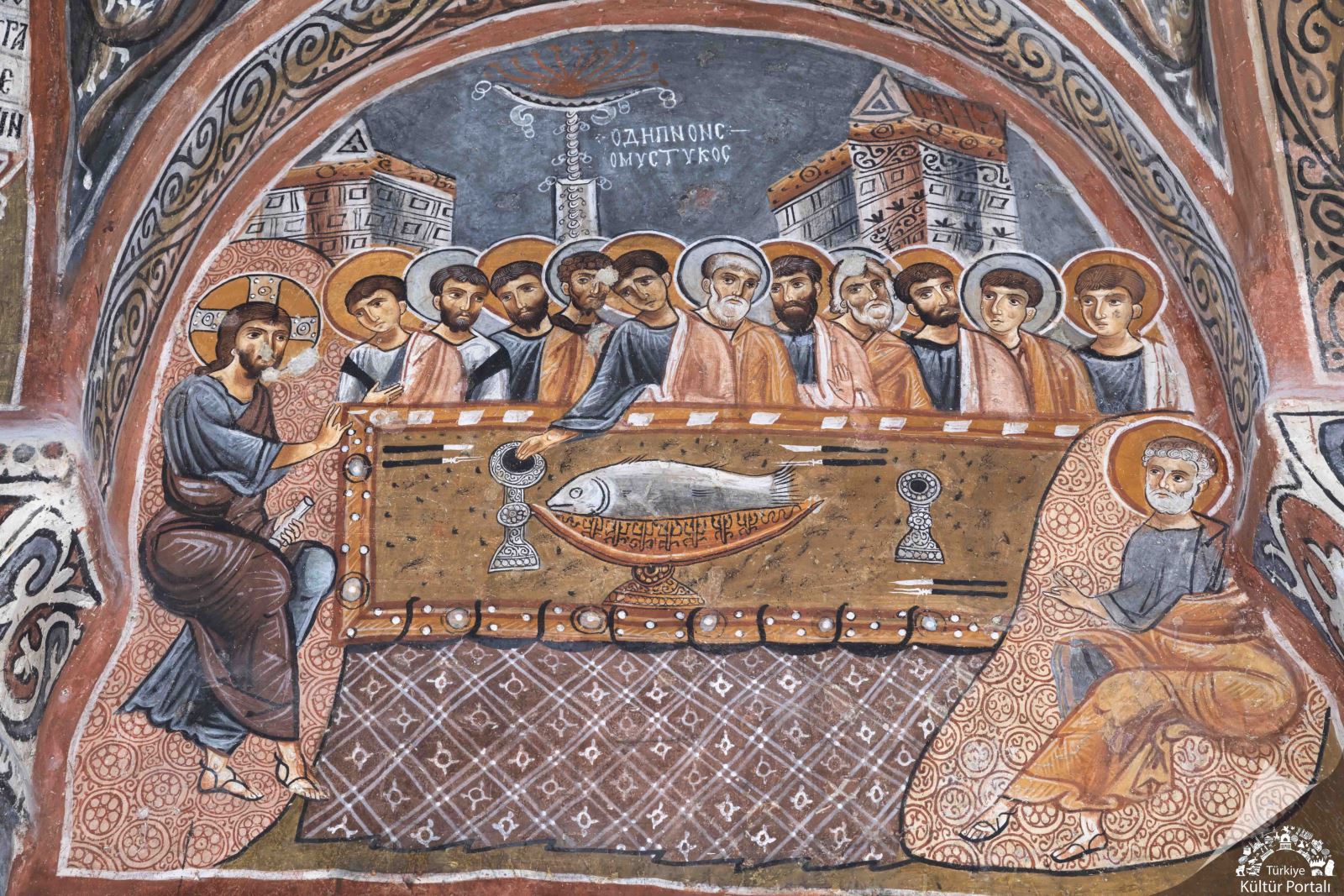
Of course, I am not talking about the real Last Supper in Jerusalem. The Gospels clearly say the meal took place in Jerusalem. I am talking about the work in which that night was painted so masterfully:
When we hear “The Last Supper”, the first thing that comes to mind is the painting by Leonardo da Vinci that stands in Milan today. Yet the frescoes that artists painted on the walls of Cappadocia’s rock-cut churches 500 years before him are still intact and have reached us almost unchanged.
In Cappadocia, churches were carved not only into the rocks but also underground. There is a church in the underground city of Kaymaklı and a chapel in Derinkuyu. Unlike the frescoed churches above ground, however, these underground churches are very plain, almost undecorated. Because the underground was dug for a far more vital purpose: survival.
The region was anything but peaceful while those frescoes were being painted. Underground cities such as Kaymaklı became the refuge of local people during the Arab-Byzantine wars between the 7th and 11th centuries. When news of a raid arrived, people took their animals and provisions, went underground and sealed the entrances from the inside. I was truly surprised when I learned that those huge round rolling stones had been made for exactly this purpose.
The story of Derinkuyu began in 1963 in the basement of a house. Tunnels that appeared by chance during a renovation revealed a city descending underground, level by level.
The Ministry of Culture and Tourism opened the city to visitors in 1967. It is accepted to have at least twelve levels, eight of which can be visited. The city takes its name, “deep well”, from the fifty-two water wells inside it.
Kaymaklı, twenty kilometres away, opened in 1964; four of its eight levels are open to visitors. The stones closing its entrances weigh up to 500 kilos and can only be opened from the inside.
Life underground was far more organised than one might think.
Derinkuyu had food stores, kitchens, stables, churches, wine and oil presses, ventilation shafts, wells and even a religious school. In Kaymaklı the stables were on the first level; it is thought that the narrow, steep corridors would have made it hard to take animals further down.
The lower levels hold rooms, a kitchen, a cellar, wine and water stores and a church. In other words, a family going underground could take a scaled-down version of its life above ground with it. These cities were used not once but many times. Before the Arab-Byzantine wars, the tunnels are said to have served during the Roman persecutions of the 2nd and 3rd centuries as well.
In 1832, people went underground once again to protect themselves from the Egyptian army that entered Anatolia under İbrahim Pasha, son of Muhammad Ali Pasha of Egypt. In 1909, when news of the events in Adana arrived, most of the people of today’s Hasaköy spent several nights in the underground rooms. History holds dozens of examples like these.
What emptied the cities for the last time was the 1923 population exchange. The region’s Greek Orthodox population was sent to Greece, and the underground cities fell silent.
So how old is this underground life?
The earliest known witness is a Greek commander. Xenophon, who recounted the retreat of Greek mercenaries in 401-400 BC, describes houses dug underground in his Anabasis. Their entrances are like the mouth of a well, but they widen below. Goats, sheep, cattle, poultry and their young live inside. Xenophon does not mention Cappadocia by name; he describes these houses while passing through Armenia, but the structure he describes matches the underground cities of the region one to one. More than two hundred underground cities with at least two levels have been found between Kayseri and Nevşehir; around forty of them have at least three levels.
In 2014, TOKİ, Turkey’s state housing agency, demolishes around fifteen hundred buildings at the foot of Nevşehir Castle for a large urban renewal project. When excavation for the foundations begins, they find a new city emerging from underground, and although 90 million liras had already been spent on the demolition, TOKİ halts construction. The area was then declared an archaeological site. According to geophysicists’ estimates, this city is about 30 percent larger than Derinkuyu. The site was partially opened to visitors in the summer of 2020.
When I researched similar structures around the world, I did not come across many examples. In Naours, near Amiens in northern France, there are three hundred rooms, three chapels and a bakery carved into limestone. In the 17th century, during the Thirty Years’ War, it sheltered about three thousand people; it was later forgotten and rediscovered in 1887.
Nushabad, near Kashan in Iran, is about fifteen hundred years old and lies at depths ranging from 4 to 18 metres. Iran promotes Nushabad as the largest underground city in the world.
To be frank, there is no internationally accepted ranking. What sets Cappadocia apart is not the size of individual cities but their number. No other region is known to hold more than two hundred underground cities together. If we also consider the series of cities not yet discovered and connected to one another underground, this points to a real history beyond mere assumption.
To return to the frescoes at the beginning of this piece:
In the Cappadocia region alone there are twenty-three Last Supper frescoes; Merve Kalafat Yılmaz catalogued them one by one in her doctoral thesis. Together with the examples in Trabzon’s Hagia Sophia and the Sumela Monastery, the number in Turkey reaches at least twenty-five.
The Tokalı Church in Göreme dates from the 10th century and is considered the oldest known rock-cut church in the region. The Elmalı (Apple) Church dates to around 1050, and the frescoes of the Karanlık (Dark) Church to the late 11th century.
These churches were not built one by one, but as part of monastic life. According to UNESCO, the first traces of monastic life in Cappadocia go back to the 4th century, when small communities following the teachings of Basil, Bishop of Kayseri, began living in cells carved into the rock. The area of the Göreme Open Air Museum was a monastic settlement between the 7th and 12th centuries. According to Özay Onur, President of the Nevşehir Chamber of Tourist Guides, the museum holds 16 churches and chapels of various sizes, and their walls were painted from the 10th century to the end of the 12th.
The thousand-year-old one is in better condition than the five-hundred-year-old one.
I did not expect to find a fresco in such good condition in the Dark Church. The work has defied the years and is today one of the best-preserved frescoes. The very darkness that gave the church its name is what protected it. There is only a small window in the entrance hall, and until the region opened to tourism the church saw almost no daylight. Leonardo’s work, on the other hand, began to deteriorate soon after it was painted, because it was done on dry plaster; despite a restoration completed in 1999, little of the original painting has survived.
So why was this scene painted so often?
According to Christian belief, this meal was the last supper Jesus shared with his disciples. As the Gospels relate, that night he broke bread and offered wine to his disciples. Christians regard this moment as the origin of Communion, the rite still practised in churches today. That is why the scene was painted so often on church walls and in monastery refectories.
Islamic tradition also remembers a table associated with Jesus and his disciples. The fifth sura of the Quran, Al-Ma’idah, takes its name from the word meaning “table”. Verses 112-115 tell how the disciples asked Jesus to ask his Lord to send down a table from heaven. The two traditions tell of this table differently, yet both remember a table set around Jesus and his disciples.
It is easy to glance at Cappadocia’s fairy chimneys and valleys and move on. But almost every rock in that landscape has a door, and behind every door there is a shelter. For centuries, people in these lands went underground at the news of a raid, rolled a 500-kilo stone shut from the inside and waited for the danger to pass. And when they came back up, they kept painting what they believed on the walls of the rocks.
The table in the Dark Church is the most enduring trace those people left us. It has outlasted wars, raids, abandonment and a thousand years. Leonardo’s may be the most famous in the world. But the one in Cappadocia is the one still standing despite everything these lands have lived through.
Sources
Leonardo da Vinci and the Last Supper
- The Last Supper, Leonardo da Vinci (Encyclopaedia Britannica)
- The Last Supper in art history, Communion and the refectory tradition (Art & Object)
- Merve Kalafat Yılmaz, Last Supper wall paintings in Byzantine-period churches of Cappadocia, doctoral thesis (Tezara)
Cappadocia’s rock-cut churches and frescoes
- Göreme National Park and the Rock Sites of Cappadocia (UNESCO World Heritage Centre)
- Tokalı Church (Küre Encyclopedia, Turkish)
- Dark Church (Küre Encyclopedia, Turkish)
- Göreme archaeological site (Küre Encyclopedia, Turkish)
- Elmalı Church, dating and restoration (ICCROM Mora Collection)
- Frescoes at Cappadocia’s Dark Church take visitors back in time (Daily Sabah / AA)
- Number of churches in the Göreme Open Air Museum, statement by Özay Onur (Sözcü / AA, Turkish)
- Frescoes of Hagia Sophia in Trabzon (Sözcü, Turkish)
- Fresco restoration at the Sumela Monastery (TRT Haber / AA, Turkish)
Cappadocia’s underground cities
- Derinkuyu Underground City (Küre Encyclopedia, Turkish)
- Derinkuyu: number of underground cities, Arab-Byzantine wars and the 1909 account (Wikipedia)
- Derinkuyu underground city, chapels and religious school (Wikipedia)
- Kaymakli underground city (Wikipedia)
- Nevşehir Kaymaklı Underground City (Turkish Ministry of Culture and Tourism, Turkish Museums)
- Rock-cut architecture of Cappadocia, Xenophon and 1832 (Wikipedia)
- Derinkuyu’s water wells (Türkgün, Turkish)
- Weight of the rolling stones (Habertürk, Turkish)
- Stables and rolling stones in Kaymaklı (Turkey Tour Organizer)
- Large Underground City Discovered in Turkey (Archaeology Magazine)
- Buildings demolished in Nevşehir (History News Network / Hürriyet Daily News)
- TOKİ’s spending and the archaeological site decision (Memurlar.net, Turkish)
- Archaeologists Unfold World’s Largest Underground City in Turkey (Smithsonian Magazine)
- Opening of the Nevşehir Underground City (Showcaves)
Examples around the world
- Cité souterraine de Naours (Atlas Obscura)
- Underground City at Naours (Michelin Guide)
- Nushabad Underground City (Atlas Obscura)
- Nushabad promoted in Iran as the “largest” (Iran Safar)
Sura Al-Ma’idah
- Al-Ma’idah 5:112 (Qurano)
- Al-Ma’idah 112-115, translation and commentary (Sorularla İslamiyet, Turkish)
Sources accessed on 21 October 2026