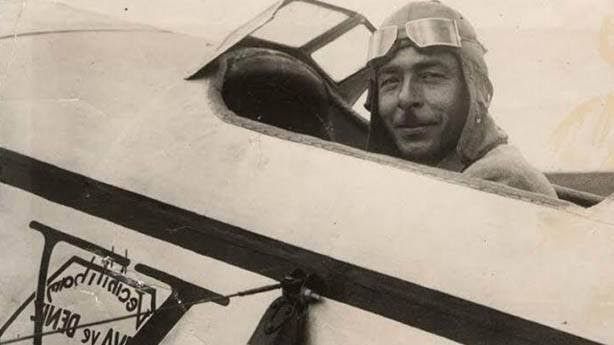
Vecihi Hürkuş, of course.
He finished the airplane he named Vecihi K-VI, which he had started building in June 1923, in December 1924. He used domestic timber, fabric and steel rods, and made it flight-ready by fitting the Benz engine from a Greek airplane captured as war booty. In his own words, “It wasn’t assembly work, it was airplane building,” and that is exactly what he did. He made the first flight over Gaziemir in İzmir. This was the first flight.
Of course, what followed is full of tragicomic stories. He managed to fly, but right afterward he was sentenced to 10 days in jail and docked pay on the grounds that he had flown without permission. The sad part is that there was no competent authority to grant flight permission. The board that grants flight permission had to include an aeronautical engineer, but since there were no aeronautical engineers at the time, the board was afraid to issue a report and kept dodging the inspection. Instead, they told him, “If you trust it, fly it and get us off the hook; if you land, we’ll give you the report.” He managed to fly the plane, but he never got that report. Although the penalty was later overturned, he could not get the plane back.
After this incident, he left the Air Force.
Yes, he was an aviator:
Vecihi Bey trained in the Ottoman era as an aircraft mechanic, in other words the technical officer; he went to Baghdad in World War I and made his first flight as an observer alongside a pilot. That flight turned into a passion. After a plane crash at the front, he returned to Istanbul and became a pilot in 1916, and even shot down a Russian plane on the Caucasus Front.
He is also the first Turkish pilot both to shoot down an aircraft and to fly a multi-engine plane.
The year is 1923
An Italian passenger plane on a world tour breaks down and makes a forced landing in Edirne. The plane cannot be repaired, and the Italians give it to Türkiye as a gift. Vecihi Hürkuş is put in charge, repairs the plane and manages to fly it from Edirne to İzmir. This is considered the first civilian flight made in Türkiye.
At the request of an aviation inspector impressed by the feat, the plane is named “Vecihi.” This event pushes him toward the idea of building his own plane.
The year is 1930
The man of firsts builds his own plane. The Vecihi XIV is the country’s first civilian aircraft.
Years later he applied for flight permission again, and again could not get approval because there was no aeronautical engineer.
Then he had a brilliant idea: He took the plane apart, shipped it by train to Czechoslovakia, reassembled it there and obtained the paperwork there. A few days later he flew back to Türkiye in his own plane. He then made demonstration flights in many cities. However, an administrative decision requiring that aircraft provided by the Ministry of Defense be used for these flights left the Vecihi XIV sitting idle.
Then, while still building aircraft, he founds the first civilian flight school. The first woman pilot, Bedriye Gökmen, graduated from this school.
In 1954, with a loan from Ziraat Bank, he founds the country’s first civilian company, Hürkuş Airlines. He buys and repairs planes that DHY no longer flies. Between accidents on its flights, sabotage allegations, competitive pressure from the state airline and bureaucratic obstacles, the company goes under.
A life full of great adventures sadly ended in poverty in 1969. He achieved so much. Perhaps it was the wrong place, the wrong time. But his name lives on in the skies.
Sources
- Wikipedia, “Vecihi Hürkuş”. Open source
- Wikipedia, “Vecihi K-VI”. Open source
- STRASAM, “Pioneer and Hero of Turkish Aviation History on the 54th Anniversary of His Death: Vecihi Hürkuş”, 2023. Open source
- Early Aviators, “Vecihi Hürkuş”. Open source
- TÜBİTAK Bilim Genç, “Vecihi Hürkuş’un İlk Yerli Uçakla Uçuşu”. Open source
- Gazete Gerçek Hayat (gzt.com), “Kafkas cephesinde uçak düşüren ilk Türk: Vecihi Hürkuş”. Open source
- Hürriyet Daily News, “Turkey remembers unsung aviation hero”. Open source
- Pegasus Blog, “Aklı Fikri Havada Bir Hürkuş”. Open source