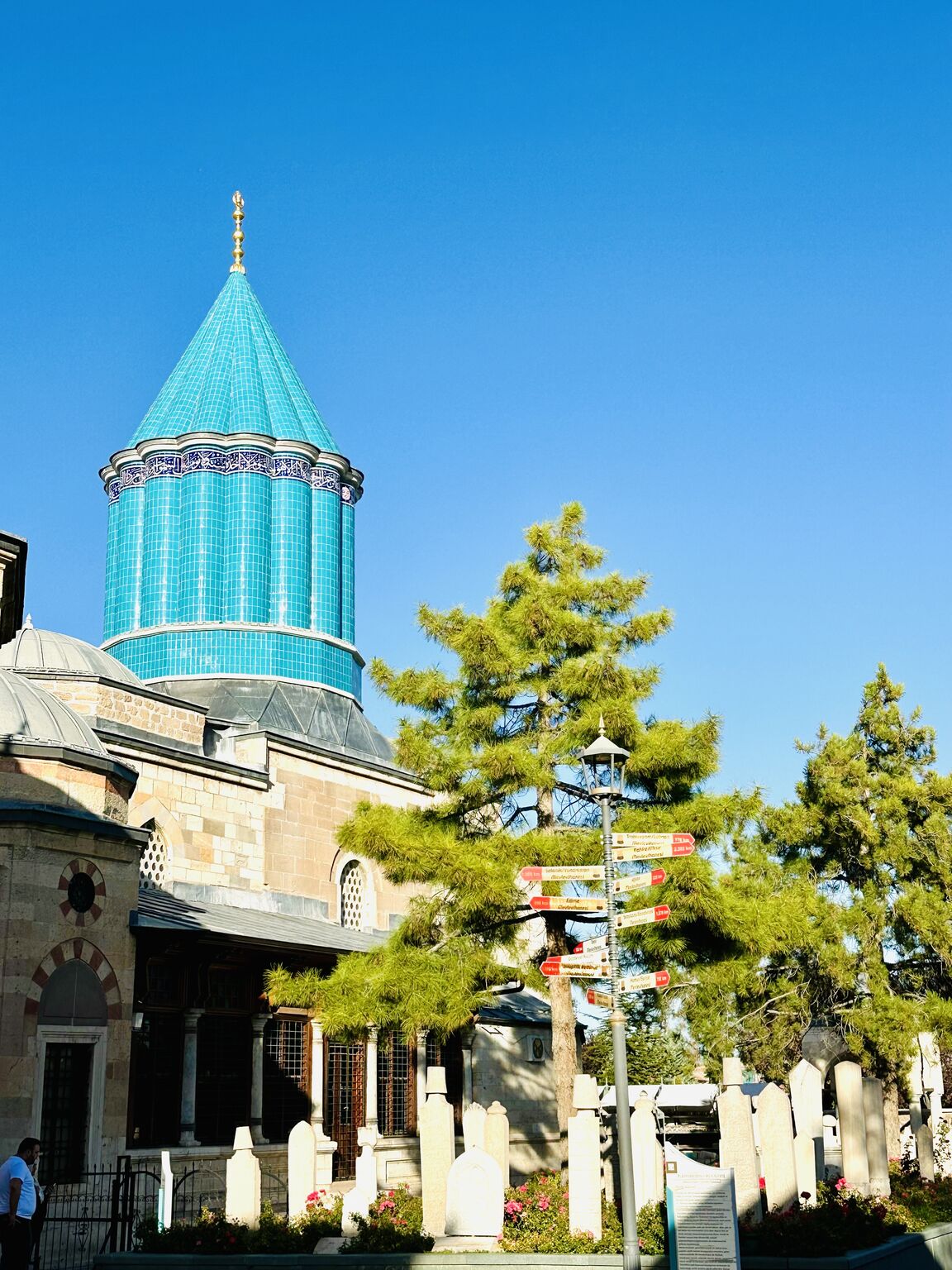
It is the Mevlana Complex, which opened its doors as a museum in 1927.
Under Law No. 677 on the Closure of Dervish Lodges and Zawiyas, which came into force on November 30, 1925, the Mevlana Lodge was exempted from closure because of its cultural inventory, and after protection and cataloging work, it was opened to visitors on March 2, 1927, under the name “Konya Asâr-ı Atîka Museum.”
The Seljuk Sultan Alaeddin Kayqubad I granted the palace’s rose garden to Mevlana’s father, Bahaeddin Veled. Bahaeddin Veled had fled the Mongol invasion with his family, migrating from the Balkh region of Afghanistan and settling in Karaman. When Alaeddin Kayqubad heard of his fame, he insistently invited him to Konya. Known by the title “Sultan al-Ulama” (sultan of scholars), Bahaeddin Veled was appointed as a professor at the palace.
After Bahaeddin Veled died in 1231 and was buried here, Mevlana took over as the spiritual leader of the lodge and turned it into a center of learning and thought.
In 1274, a year after Mevlana’s death, the notables of Konya had the Kubbe-i Hadra (Green Dome) built by Bedrettin Tebrizi, one of the great architects of the time. Resting on four thick columns, the Green Dome takes the form of a 16-segment conical cap and is covered with green / blue tiles. This structure, which makes the mystical site visible from kilometers away, is also one of the symbols of Konya.
We are talking about a tradition of more than 800 years.
Although it suffered earthquakes, fires and destruction, the building was restored in the Seljuk, Ottoman and Republican periods. I’d like to share some of the major works:
Construction of the Kubbe-i Hadra (Seljuk, 1274)
Hand-Painted Ornamentation (Yavuz Sultan Selim)
Sema Hall and Dervish Cells (Suleiman the Magnificent, Bayezid II)
Post-Earthquake Restoration (Mustafa II)
Detailed Post-Fire Renovation (Abdulhamit)
In the Republican era, there have been more than ten maintenance and restoration projects.
The lodge never stood still as a structure; it was developed through systematic repairs and additions in every political era.
Today, with an average of around 3 million visitors a year, the Mevlana Museum is one of Türkiye’s top three most visited and highest-earning museums.
I close this post with a beautiful saying of Mevlana:
“There is no locked door, only the wrong key.”
Sources
- TDV İslâm Ansiklopedisi, “Mevlânâ Müzesi”. Open source
- TDV İslâm Ansiklopedisi, “Mevlânâ Külliyesi”. Open source
- TDV İslâm Ansiklopedisi, “Bahâeddin Veled”. Open source
- T.C. Kültür ve Turizm Bakanlığı, “Mevlana Museum” broşürü, 2015. Open source
- Wikipedia, “Mevlana Museum”. Open source
- Türkiye Maarif Vakfı Küre Ansiklopedisi, “Mevlâna Müzesi”. Open source
- TRT Haber, “Mevlana Müzesi 3 milyonun üzerinde ziyaretçi ağırladı”, 5 Ocak 2025. Open source
- Daily Sabah, “Restorations reveal 500-year-old handiwork in Rumi’s tomb in Konya”, 17 Ocak 2019. Open source
- Sözcü, “Tarikata, cemaate manifesto: 677 sayılı devrim kanunu”. Open source