The world’s first coffeehouse opened in 1554 in Tahtakale, Istanbul.
From here, coffee passed through the Balkans to Italy.
Today Espresso is a global phenomenon,
while Turkish Coffee is known only in a limited geography.
There’s a similar story with yogurt:
“Yogurt,” a word that entered the literature from Turkish.
It was positioned on the world market under the name Greek Yogurt.
Yes, our topic is “Geographical Indication” and “Value Management”
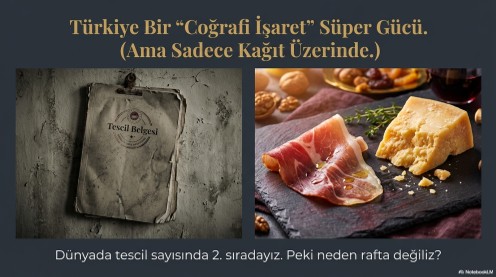
In 1994, the World Trade Organization’s TRIPS Agreement established a global protection framework for geographical indications.
Türkiye put this system into effect in 2017.
Today there are more than 1788 products with a geographical indication in Türkiye.
With this number, we are in the top three in the world.
But only 44 of our products have EU registration.
The number of EU-registered products in other countries:
Italy 892; France 780; Spain 380; Greece 282;
This gap is reflected in tourism revenues as well;
Gastrotourism revenue in Italy and France is about 25% of total tourism revenue.
Türkiye has only just passed the 15% level.
Why?
Is a geographical indication a form of protection for us,
Or a tool for designing revenue and experience?
Take Turkish Coffee, for example:
The only coffee in the world that is made by being cooked.
But because of cost, even the beans of the coffee we drink have started coming from Brazil.
Since beans from Yemen are expensive, Rio Minas beans took 90% of the market.
Perhaps it’s far from the taste it had when it entered the UNESCO Heritage List.
Italy, on the other hand, turned espresso into a lifestyle with the best beans + standards + the city experience.
It preserves its well-known quality form.
“Same product, different management”
We see the same thing in product comparisons:
Toscano Olive Oil and Milas Olive Oil,
Feta and Ezine Cheese,
Bresaola and Afyon Pastırma,
Roquefort and Erzincan Tulum…
What sets them apart after registration is very simple:
For them it’s the beginning; for us it becomes the end.
In short;
Some products become one with their destination and stay in memory,
Others become ordinary in their own country.
Sources
- TDV İslâm Ansiklopedisi, “Kahvehane”. Open source
- Wikipedia, “Coffeehouse”. Open source
- Wikipedia, “TRIPS Agreement”. Open source
- WIPO Lex, “Decree-Law No. 555 of June 27, 1995, on the Protection of Geographical Indications”. Open source
- Yavuz Tekelioğlu, “Coğrafi İşaretler ve Türkiye Uygulamaları”, Ufuk Üniversitesi Sosyal Bilimler Enstitüsü Dergisi, S. 15, 2019. Open source
- TRT Haber, “Bakan Kacır: Türkiye coğrafi işaretli ürün zenginliği açısından dünyada ikinci sırada”, 15 Aralık 2025. Open source
- WIPO, “World Intellectual Property Indicators 2025: Geographical indications highlights”, 2025. Open source
- Sorin Stanciu vd., “Evolution of Geographical Indications in European Union Based on eAmbrosia”, Scientific Papers Series Management, Economic Engineering in Agriculture and Rural Development, 20(4), 2020. Open source
- UNESCO, “Turkish coffee culture and tradition”, 2013. Open source
- Hürriyet Daily News, “Türkiye eyes bigger slice of global gastronomy tourism”, 30 Eylül 2025. Open source