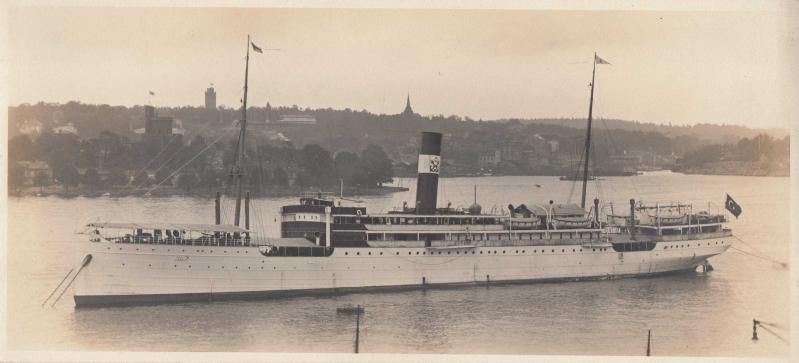
The early years of the Republic.
No budget.
But a big vision:
Let’s tour Europe on a ship,
and introduce Türkiye.
86 Days, 12 Countries, 16 Ports
In my view, we pulled off a multifaceted undertaking worthy of being taught as a course in modern schools.
We’re talking about 100 years ago.
As a state just out of war, under the conditions of the day, on a shoestring budget, we showed the world how promotion is done.
It’s impossible not to be inspired:
The project was directed by the famous Ali Sami Yen, founder of Galatasaray SK.
20 categories, hundreds of products.
An Anatolian mosaic was created.
A deep portfolio stretching from Kütahya tiles to Hereke carpets.
Even the Presidential Symphony Orchestra accompanied this voyage.
To convey the perception of a “New Türkiye” to the West, modern balls were held on board,
and gastronomy presentations were made that showcased Anatolian cuisine at its best.
The Modern Türkiye Shock
Yes, the European press announced this event with headlines in a similar tone.
Europe and Russia showed tremendous interest.
Most importantly, Europe met the modern Turkish people.
This voyage gained Türkiye a great deal.
The young Türkiye was coded as “A modern country worth visiting.”
Well-known figures who left their mark on the era were hosted on board,
This made it possible to generate content in Türkiye’s favor through the opinion leaders of the time. (Influencer marketing for that era)
This undertaking with the Karadeniz Steamship in 1926, with the limited budget of the day and in a difficult climate, is a project that should serve as a model even today.
Although the world literature includes commercial attempts such as the Russian Traveling Exhibitions launched in 1909, the Karadeniz Steamship is the first project focused on selling an identity, and it stands apart from the other examples.
This effort is also the integrated, socio-cultural forerunner, 40 years earlier, of the floating fair concept that Japan used with the “Sakura Maru” in the 1960s to spread its industrial power around the world.
In other words, it’s “The First.”
In 1926, a war-weary country somehow told its story to the world.
So what about today, 100 years later?
With so many more resources at our disposal,
How well are we able to tell our story to the world?
Sources
- Celil Bozkurt, “Türkiye Cumhuriyeti’nin Bir Propaganda ve Tanıtım Hamlesi: 1926 Seyyar Sergi ve Avrupa Seyahati”, Belleten, 83(298), 2019. Open source
- Wikipedia, “SS Karadeniz”. Open source
- Sözcü, “İşte 95 yıl önce hayata geçirilen, Türkiye’nin en özgün ve öncü tanıtım projesi ‘yüzen sergi’nin unutulan gerçek öyküsü”, 2021. Open source
- Pera Palace Hotel, “The Project Where Atatürk Introduced Contemporary Turkey to the World: Karadeniz Seyr-i Türkiye”. Open source
- Wikipedia, “Ali Sami Yen”. Open source
- Ship Stamps Society, “SAKURA MARU built in 1962”. Open source
- İstanbul Ansiklopedisi Arşivi (Kadir Has Üniversitesi / SALT), “Yüzen Fuar İstanbul’a geldi” (Japon sergi gemisi Sakura Maru), 21 Aralık 1962. Open source