Because the number existed before the list. For the Ionians, seven was sacred, and there are dozens of sacred sevens such as the seven planets, the seven sages and the seven gates. Even though 18 ancient lists compiled at different times include 22 different structures, in the end we are always left with seven.
Today’s list came from the hands of a Dutch painter and an engraver in 1572. Dozens of copies printed from copper plates have survived to this day, and you can view all of the works online at the Rijksmuseum in Amsterdam.
The work is titled Octo Mundi Miracula (The Eight Wonders of the World)
The drawings are by Heemskerck, the engravings by Galle.
I said eight, because the Colosseum in Rome was originally on this list. However, the Colosseum was never on the ancient list, and since it was not embraced, later compilers left it off their lists.
The ancient Greeks called them “Ta hepta theamata tēs oikoumenēs,” meaning the seven sights of the inhabited world.
When Alexander destroyed the Persians in 330 BC, Egypt, Persia and Babylon opened up to Greek-speaking travelers, who then began listing what they saw. In other words, the list is limited to the world those travelers knew and could reach.
In 1572, when the works were printed, only the Pyramid of Giza was still standing.
The Temple of Artemis and the Mausoleum at Halicarnassus on the list are located in our country. The Mausoleum in particular has an interesting story:
After the death of Mausolus of Caria in 353 BC, a magnificent tomb was built by his wife and sister, Artemisia II. The tomb consisted of a high podium, 36 columns above it, a 24-step pyramid on top of those, and carved reliefs.
The word “mausoleum” we know today comes from this structure.
The structure was damaged by earthquakes between the 12th and 15th centuries, and its pieces were used in building Bodrum Castle.
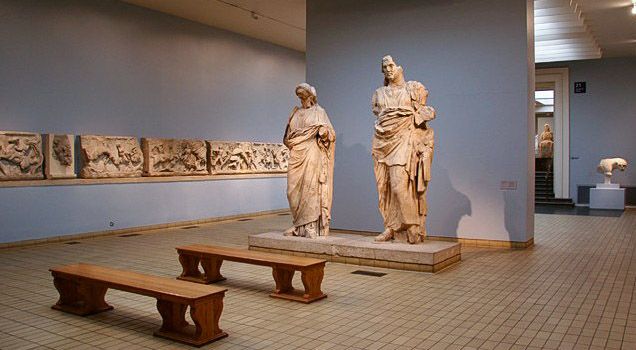
When travelers recorded this in their journals, the matter drew the attention of the British state, which made repeated attempts. In 1846, British Ambassador Canning obtained a firman from Abdülmecid for the removal of the reliefs in the castle, and twelve reliefs reached the museum as a gift from the sultan. In 1852, a British Museum employee named Charles Newton was appointed vice-consul in Mytilene; he was the museum’s artifact hunter in the Aegean. With an excavation firman in hand, Newton arrived in Bodrum by ship in 1856, found the site of the Mausoleum and dug it up. Within three years he left our country with three shiploads of artifacts.
Years later, Cevat Şakir Kabaağaçlı, the Fisherman of Halicarnassus, sent a telegram to the management of the British Museum calling for the return of the artifacts: “This wondrous structure was created not for the foggy skies of London, but for the clear blue skies of Caria.” The museum officials, of course, did not return them, but legend has it they sent back an insolent reply: “Don’t worry, we have painted the wall of the gallery blue.”
The Mausoleum is one of thousands of artifacts torn from our country during the final period of the Ottoman Empire. As the Fisherman of Halicarnassus put it:
“Until now, we have scattered our heritage to the four winds like spendthrift heirs. During the Ottoman state, the tangible artistic remains of the Seven Wonders of the World ended up, as if they were their fathers’ property, in the various museums of the West, where they are now.”
Sources
- Wikipedia, “Seven Wonders of the Ancient World”. Open source
- Wikipedia, “Octo Mundi Miracula”. Open source
- Wikipedia, “Mausoleum at Halicarnassus”. Open source
- Wikipedia, “Bodrum Castle”. Open source
- Wikipedia, “Charles Thomas Newton”. Open source
- Cornucopia, “Digging for Glory”. Open source
- British Museum, Koleksiyon kaydı 1857,1220.478 (Halikarnas Mozolesi bloğu). Open source
- The Art Newspaper Türkiye, “Müzeleri dekolonize etmek mümkün mü?”, 31 Ocak 2024. Open source
- Cumhuriyet, “Halikarnas Balıkçısı’nın mektubundan ilham alan besteye İngiltere ve ABD’den ödül”, 16 Mayıs 2022. Open source