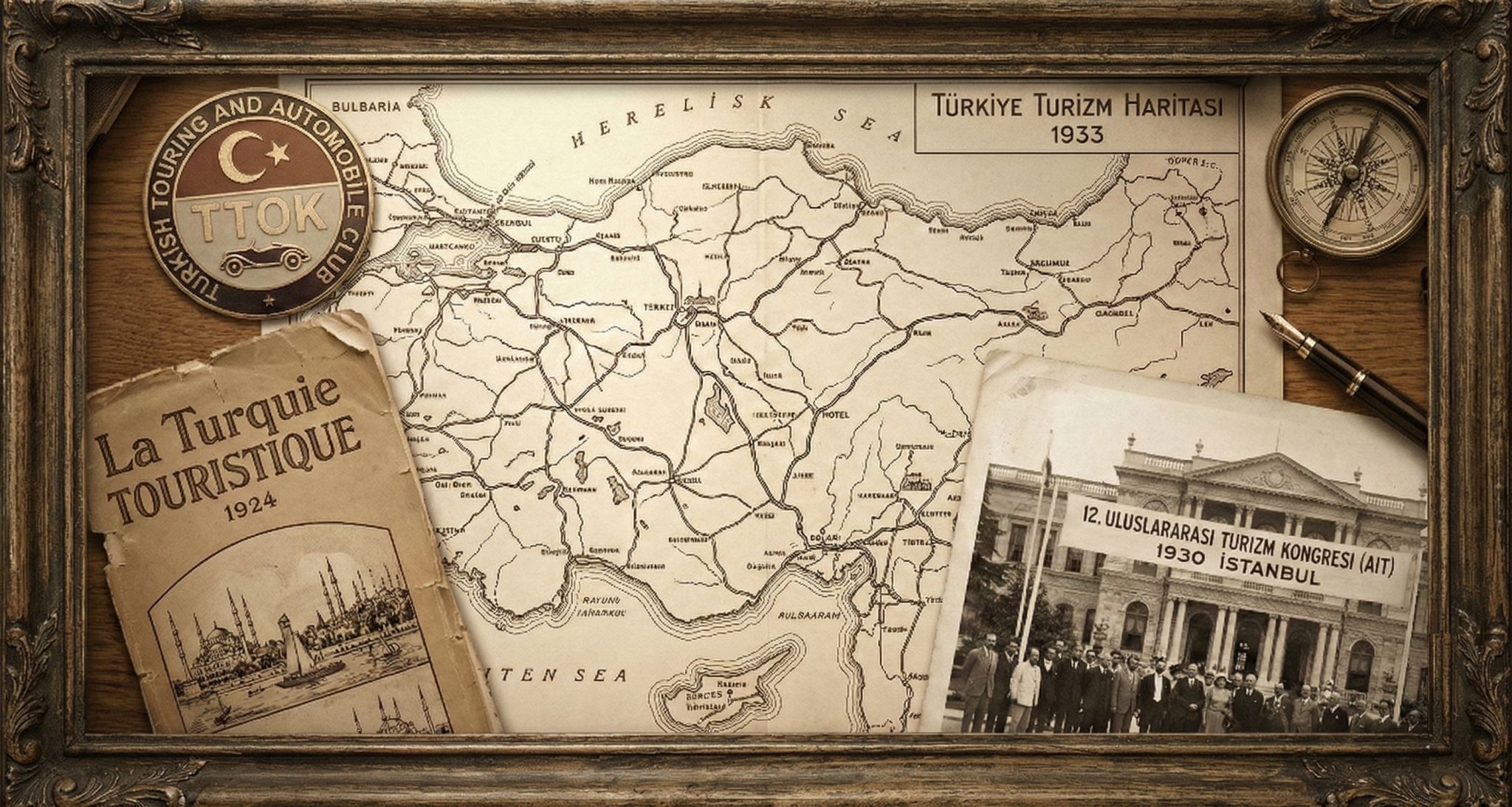
Just 8 days after the proclamation of the Republic,
it was founded on November 6, 1923, by Reşit Saffet Atabinen and his colleagues under the name “Turkish Travelers’ Society.”
It is the first civil society organization brought to life with the vision of the young Republic.
In 1930 it took its current name and, with its status as an association working in the public interest, assumed the role of an “unofficial ministry of tourism.”
In the years when tourism was not yet recognized as a sector, it achieved many firsts:
1924: As its first promotional activity, French-language “La Turquie Touristique” brochures were printed and distributed across Europe.
1926: Türkiye’s first professional tourist guide courses were opened.
1930: The first traffic signs and direction signs were put up on intercity roads.
1933: The first Tourism Map of Türkiye was published, including details on accommodation, fuel and ancient cities.
Türkiye’s first Tourism Congress:
The 12th International Tourism Congress (AIT) convened in 1930 at Dolmabahçe Palace and Galatasaray High School in Istanbul.
Held with the participation of 24 countries, this congress enabled Türkiye to take a seat at the global table for the first time on international customs facilitation, visa regimes and tourism standards.
Professional Guiding:
Thanks to this discipline, guiding became a qualified profession. Candidates were required to have knowledge of history, archaeology and art in addition to languages.
Guiding exams were held in 1925 and 1927.
In this way, the foundations of today’s respected Turkish Guiding System were laid
The First Map: 1933
In those days, apparently, tourism brought only Istanbul to mind.
With Turing, routes outside Istanbul came to life:
Western Anatolian and Black Sea routes were created, and all the ancient cities along them, important tourist information, and even gas stations were shown on the map. This was the first time Anatolian routes were documented professionally.
UNESCO Success
Around 50 buildings were restored by Turing under the leadership of Çelik Gülersoy.
Works on the UNESCO World Heritage List, such as Safranbolu, Soğukçeşme Street and the Green House (Sultanahmet Square), drew attention thanks to Turing’s work.
Institutional Handover
With the establishment of the Ministry of Tourism and Promotion in 1963, Turing handed over to the state the strategic promotion mission it had carried out for 40 years.
Today it still continues its mission as the institutional memory and quality auditor of Turkish tourism through customs documents (triptyque), cultural publishing and boutique restoration projects.
Sources
- Güngör Toplu ve Yaşar Semiz, “Türing Otomobil Kurumu Kuruluşu, Düzenlediği Uluslararası Kongreler, 1930’lu Yıllardaki Diğer Faaliyetleri”, Akademik Tarih ve Araştırmalar Dergisi, S. 9, 2023. Open source
- Erol Evcin, “Türkiye Cumhuriyeti’nin İlk Yıllarında Turizm ve Tanıtma Faaliyetleri”, Atatürk Yolu Dergisi, S. 55, Güz 2014. Open source
- Gürsoy Şahin, “Atatürk Döneminde Batı’daki Olumsuz Türk ve Türkiye İmajını Düzeltme Çabaları ve Türk Seyyahin Cemiyeti’nin Bu Konudaki Çalışmaları”, Afyon Kocatepe Üniversitesi Sosyal Bilimler Dergisi. Open source
- Burak Karcı, “Cumhuriyetin İlk Yıllarında Türkiye’de Turizmin Geliştirilmesine Dair Örnek Bir Rapor”, Anatolia: Turizm Araştırmaları Dergisi, 34(3), 2023. Open source
- Türkiye Turing ve Otomobil Kurumu, “History of Touring”. Open source
- Wikipedia, “Touring and Automobile Club of Turkey”. Open source
- Yusuf Ormankıran, Ali Turan Bayram ve Ercan Karaçar, “Turizm Bakanları Üzerine Bir İnceleme”, Turizm Akademik Dergisi, 2(2), 2015. Open source
- Wikipedia, “Çelik Gülersoy”. Open source
- Wikipedia, “Safranbolu”. Open source
- Wikipedia, “Historic Areas of Istanbul”. Open source