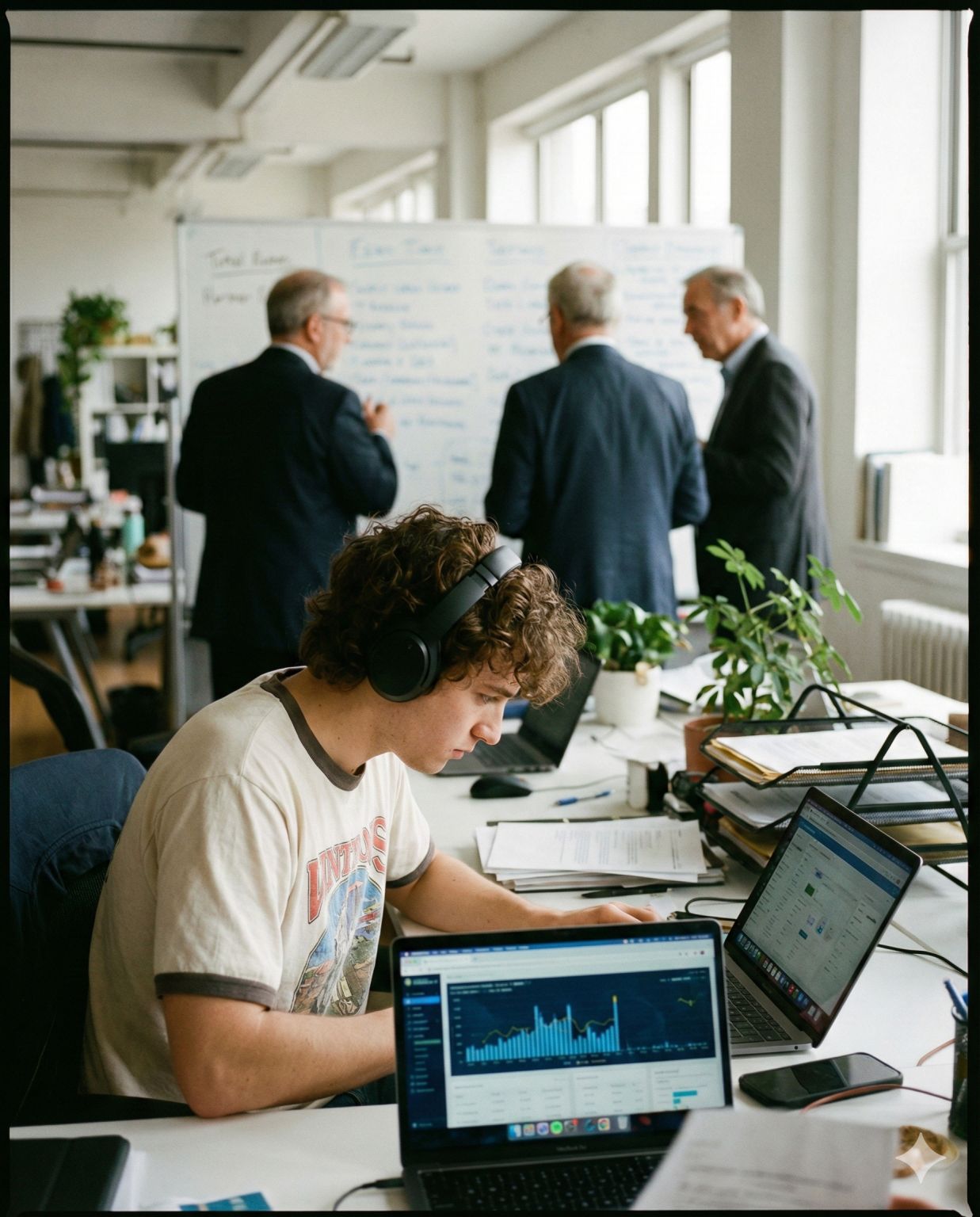
There’s one reality that’s bound to come up in conversations among those of us from Generation Y, and partly Generation X: “Generation Z” 😊
Here are a few lines that will sound familiar to you, too:
🙉 “Their career plans change every 6 months. Entrepreneur on Monday, YouTuber on Tuesday, Collective Consciousness Expert on Wednesday… We sat at the same desk for 20 years.”
🙉 “The moment they hear a little criticism, they slap a ‘toxic’ label on the workplace and sulk. Our boss used to flip the table, and we still kept on working.”
Is it really like that?
I wanted to examine, with some data, whether the shift between generations is really this harsh.
Because the numbers tell a clearer story than emotional commentary:
Busy Bees
As of the end of 2025, Generation Z makes up roughly 27% of the global workforce. But in the Tourism and Service sector, that figure is approaching 60%. In other words, the “field” is entirely in their hands.
Brain and Labor Drain
According to TurkStat (TÜİK) 2024 data, the largest share of the population emigrating from Türkiye is the 20-29 age group. If you think only engineers are leaving, you’re mistaken; trained and qualified service staff are leaving simply for a livable life.
Cost of Living
According to the Deloitte Gen Z & Millennial Survey, this is Generation Z’s biggest concern.
In studies conducted specifically in Türkiye, the share of those who say, “I have a chance of becoming a homeowner by working,” is at a historic low compared with the period when previous generations started working.
Why?
Because the home and car goals that until recently could be reached with a single salary and patience are becoming mathematically unattainable, especially in the inflationary environment brought on by the pandemic economy.
In other words, rather than looking at things as dreamers, the new generation approaches the issue more realistically.
So What’s the Solution?
Not Pessimism, but Structural Transformation:
Advanced economies like the US and the UK overcame this crisis 10 years ago with the “Gig Economy” (Flexible/Project-Based Work) model. There, rather than being a salaried employee of a single company, locked into a 9-to-6 schedule, a software developer or marketer provides “output-based” services to 2-3 different projects at the same time.
Our way out in Türkiye is not to give in to the worry that “young people are breaking away from the system,” but to read this global transformation correctly and integrate it into the system.
Our current labor law and working models need to be updated to move beyond the single-employer structure and to safeguard multiple and flexible employment.
An environment in which this model is supported by a legal framework and incentives will both relieve employers of cost pressure and increase employees’ income and well-being.
Our vision for the future should not be to confine employees to working hours,
But a system that frees them in proportion to the value they create and encourages an auditable, flexible working model.
Dear Generation Z,
How do you see it? What do you think?
Sources
- Deloitte, “2025 Gen Z and Millennial Survey” (rapor, PDF), 2025. Open source
- Deloitte, “Gen Z and Millennial Survey” (anket ana sayfası). Open source
- Alomaliye (TÜİK bülteni), “Uluslararası Göç İstatistikleri, 2024”, 24 Haziran 2025. Open source
- Cumhuriyet, “2024’te Türkiye’den en fazla 20-24 yaş grubundakiler göç etti” (TÜİK verisi), 24 Haziran 2025. Open source
- World Economic Forum, “Gen Z unemployment chart: global comparisons”, Mart 2021. Open source
- Top Employers Institute / PRWeb, “New study by Top Employers Institute reveals how Gen Z is shaping the future of work”, 19 Eylül 2024. Open source
- Deputy, “The Big Shift 2026: Key Trends Transforming the Hospitality Industry”, 2026. Open source