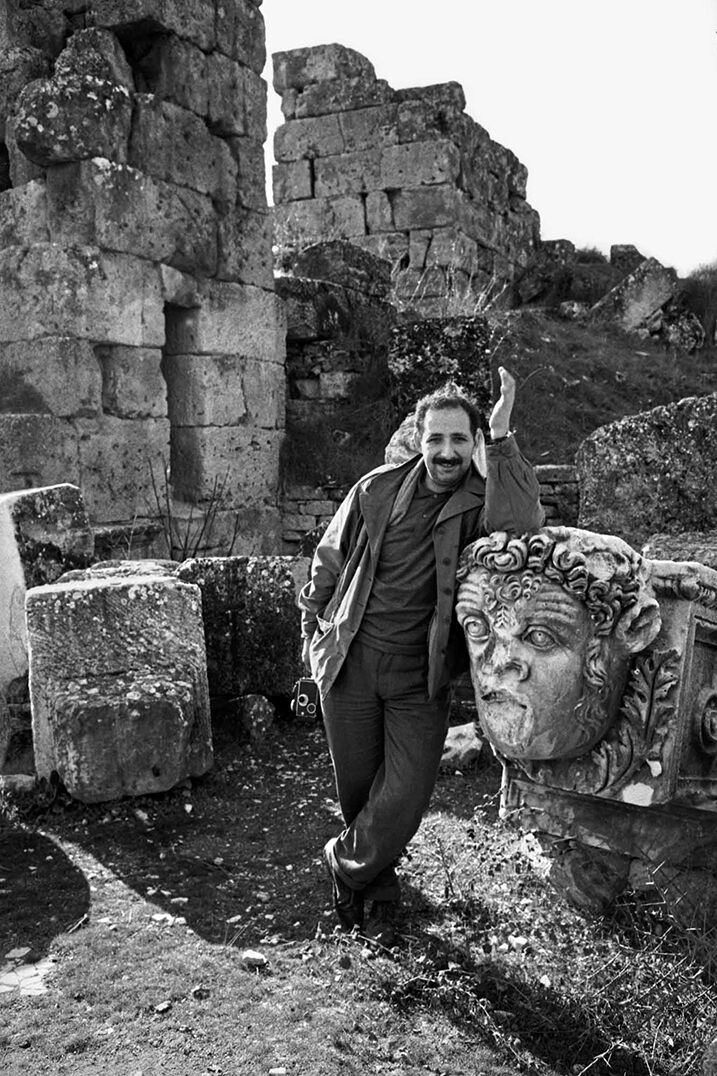
The year is 1958. Ara Güler goes to Aydın to photograph the opening of a dam. To get the whole dam in the frame, they climb very high, to places even the driver doesn’t know. He struggles all day and even gets into a fight with the driver. On the way back in the evening, the driver takes what he thinks is a shortcut and gets lost.
They stop for the night in a small village called Geyre. This is where the real adventure begins:
When he walks into the village coffeehouse, he is stunned by what he sees: Men are playing cards by the light of a gas lamp on top of an ancient Roman column capital. Imagine, there isn’t even electricity.
Early in the morning he sets out with his camera to explore the village.
The villagers wash their laundry in the sarcophagi and press grapes and strain olive oil in them too. In short, he discovers that the locals are living inside history. He even says, “History and the present live intertwined. I have never seen a place like this anywhere in the world.”
After returning to Istanbul, he shares the photos with the local press, but no one is interested. He has his wife translate his account and sends it to the British magazine Architectural Review, which publishes it as a 4-page piece.
Later, the famous American magazine Horizon contacts Güler and asks for photos and an article. He then went back for 3 days and took color photographs. Horizon was the most important magazine of its day and wanted a distinguished name to write the story, so it reached out to philologist Prof. Kenan Erim of New York University, and the article was published under his byline.
Erim launched the excavations on behalf of NYU in 1961 and kept working there until his death. In accordance with his will, he was buried in the city with special permission from the government. In 1995, Oxford University also joined the excavation.
Aphrodisias was inscribed on the UNESCO World Heritage List in July 2017. Why?
Because the urban fabric, the marble quarry, the workshop where the sculptures were made and the academy that trained sculptors for that workshop are all together. It is the only example in the world that brings all of these together in one place, and also one of the most multilayered ancient cities. We’re talking about 7,000 years of history. In the theater area there are remains dating to 5800 BC.
Regarded as a pilgrimage site by pagans, Aphrodisias hosted pilgrims from the surrounding region.
So much so that a city of 15 thousand people had a stadium for 30 thousand and a theater for 8 thousand. In other words, a capacity to host about 40 thousand people at once.
The city was also a favorite of the Roman Emperors: During Rome’s civil wars, Antony confirmed the right of asylum at the Temple of Aphrodite, and the city gained the status of religious inviolability.
“It is the one city from all of Asia that I have chosen for myself,” said Augustus, mentioning it in a letter he wrote in 38 BC.
Thanks to this favor, the city paid no taxes to Rome for 300 years.
The Aphrodisias Museum was founded in 1979 to display the finds. The best-known pieces unearthed in the excavations are exhibited here.
We would still be talking about this city today, but we certainly wouldn’t be hearing such a passionate story. Anatolia knows so much that it must teach the world all over again, and it never fails to surprise us.
Passing world heritage on to future generations under this flag is a special source of pride.
Sources
- Smithsonian National Museum of Asian Art, “Ara Güler and the Lost City of Aphrodisias”. Open source
- Aphrodisias Ören Yeri, “Who is Ara Güler?”. Open source
- Habertürk, “Ara Güler’in keşfettiği kent: Aphrodisias”, 18 Ekim 2018. Open source
- Aphrodisias Ören Yeri, “Professor Doctor Kenan Tevfik Erim”. Open source
- Oxford University, “Aphrodisias Excavations”. Open source
- Aphrodisias Excavations (NYU), “About the Project”. Open source
- UNESCO World Heritage Centre, “Aphrodisias”. Open source
- Britannica, “Aphrodisias”. Open source
- Aphrodisias Ören Yeri, “About Aphrodisias”. Open source
- Aphrodisias Ören Yeri, “Aphrodisias Museum”. Open source