According to Stanford University experts: No, it’s not bursting. But “The Party’s Over”
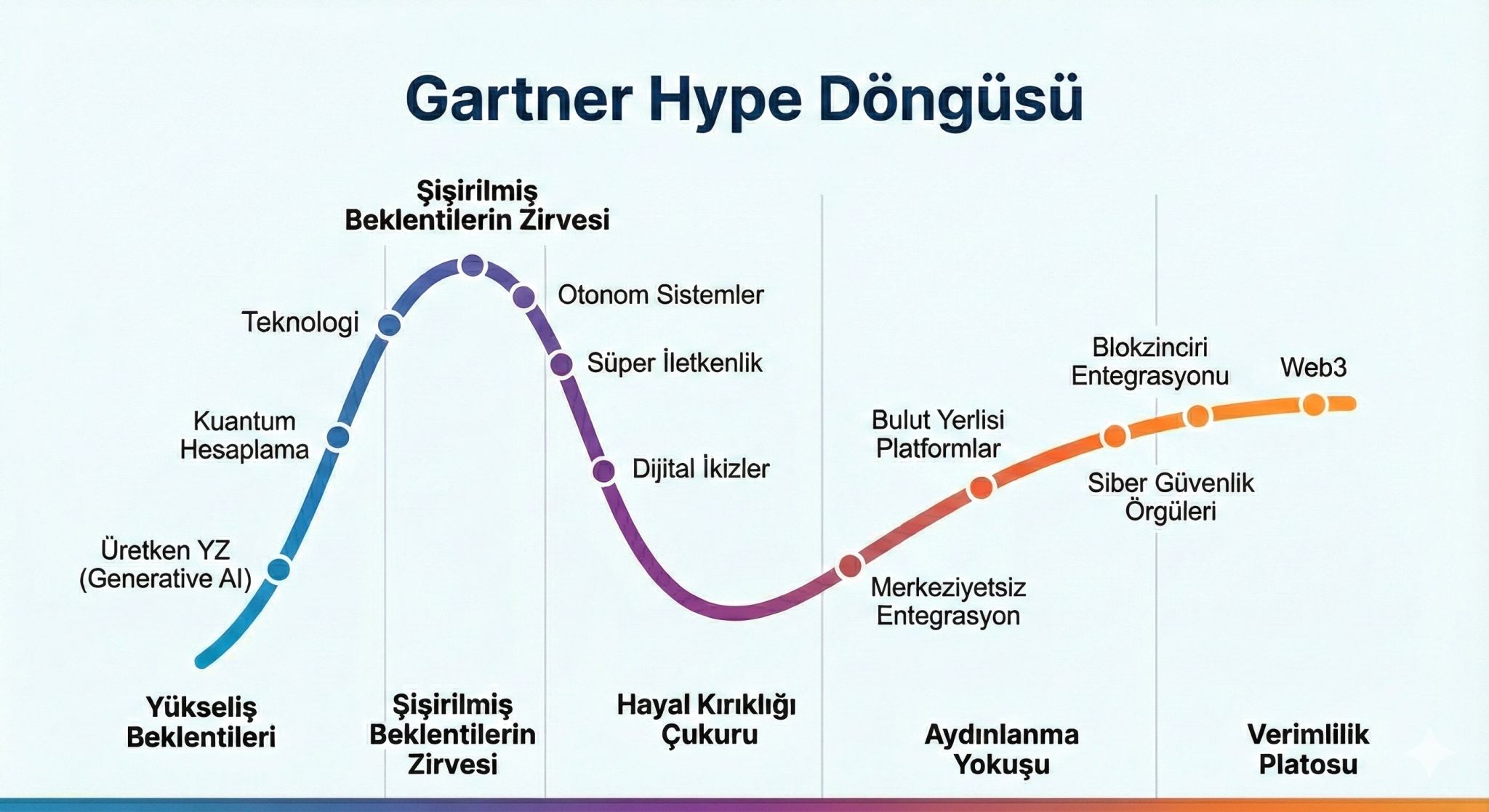
To read this process correctly, it’s enough to look at Gartner’s Hype Cycle Theory: “The bubble is deflating, but tangible value remains.”
This decline shouldn’t be seen as an end. It is a necessary process of maturation in which the technology grows out of its childhood and turns into an efficiency-focused industrial tool.
Here are the key highlights about this period of maturation from the Stanford University HAI Report:
AI Sovereignty: “National AI”
We will hear this concept very often in 2026. According to Stanford HAI Co-Director James Landay, countries will reduce their technological and political dependence on the major US-based AI providers, and development will take place along two main models:
A country building its own language model (LLM) from scratch, suited to its own cultural and linguistic characteristics.
Taking a powerful model developed by another company and running it on its own servers, guaranteeing that its citizens’ data does not leave the country’s borders.
Medical Innovation
According to Professor Curt Langlotz, 2026 will see an explosion of innovation in health technologies.
Falling development costs will allow more startups to enter the market, leading to faster development of diagnostic tools and the spread of personalized medicine. This will stand out as one of the most promising areas where AI can deliver tangible, life-saving benefits to humanity.
A New Task in Science: Opening the Black Box
The scientific world now demands that AI not only give correct answers but also explain how it arrived at them. In Professor Russ Altman’s words, opening AI’s black box in science has become an absolute necessity. Accordingly, researchers are no longer interested only in the model’s output. Instead, through what Altman calls “the archaeology of high-performing neural networks,” the internal mechanisms that deliver high performance will be built.
The Hype Bubble Is Deflating
Stanford Communication Professor Angèle Christin argues that 2026 is the year AI moves from speculation to tangible benefit. She underlines that 2026 will be the year of moving away from the “AI solves every problem” approach toward the reality that “AI is a great tool for certain tasks.”
In parallel with this search for realism, Stanford HAI Co-Director James Landay predicts that in 2026 more companies will admit that AI has not yet delivered the expected productivity gains. We may even hear many stories of “failed AI projects.”
So, what does this mean?
This is not failure; it’s growing pains. Companies will shift money and talent to where they actually pay off.
The era of “Measure it with data, cut the empty talk.” is coming.
Sources
- Stanford HAI (Shana Lynch), “Stanford AI Experts Predict What Will Happen in 2026”, 15 Aralık 2025. Open source
- Stanford Report, “Stanford AI experts predict what will happen in 2026”, 15 Aralık 2025. Open source
- Wikipedia, “Gartner hype cycle”. Open source
- TechRepublic, “Gartner: Gen AI is in the ‘Trough of Disillusionment,’ Yet Spending Expected to Increase Through 2028”. Open source