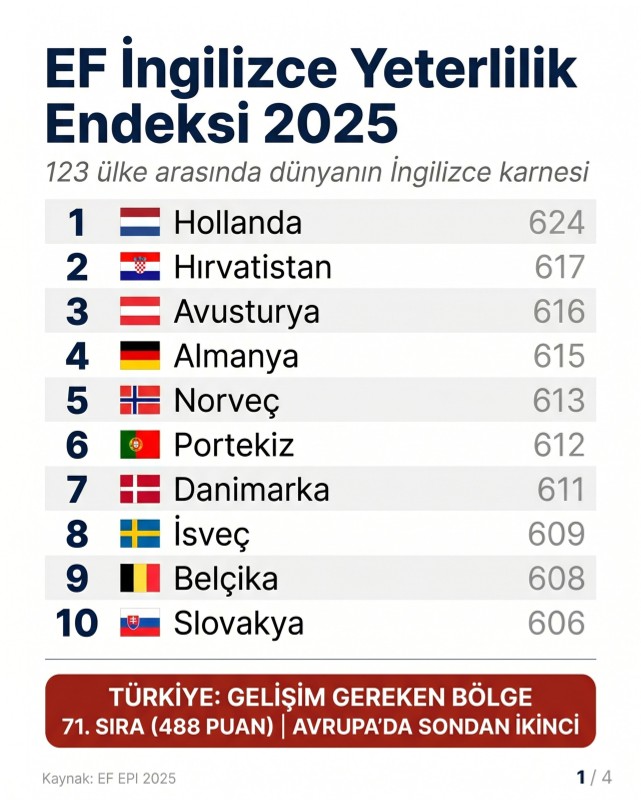
Yes, according to the “EF English Proficiency Index,” we ranked 71st out of 123 countries in 2025.
As a country that has passed the 60 million tourist mark, foreign languages are one of our most important issues.
Especially since the new education system, we actually receive serious foreign language instruction: Every student takes more than 1,000 hours of English classes over 12 years, making us one of the countries with the most instruction in this field.
South Korea, for example, spends $22 billion a year, and a Korean student gets 3 times more hours of English in total than a student in Türkiye.
Despite all that investment, they rank 48th.
The Netherlands, on the other hand, ranks first in the world despite providing fewer hours of instruction.
One of the main reasons is that we learn the language to pass exams. Afterward, it simply melts away. We also shy away from talking to foreigners for fear of embarrassing ourselves.😊
There is no dubbing on Dutch television; children develop an ear for the language before they even start school, and they watch films and digital content in the original language.
As a result, about 90% of the population speaks English; in Türkiye, the figure is 20%.
Add the Netherlands’ small population and export-driven economy, and knowing the language becomes a necessity.
In Türkiye, however, you can live a whole lifetime without ever using English.
The same problem exists with Arabic. Arabic instruction in Türkiye is largely Quranic Arabic. Yet the everyday dialects spoken in Egypt or Saudi Arabia are something else entirely. Knowing Quranic Arabic isn’t enough to communicate with an Arab at the negotiating table. I often read about this in Murat Bardakçı’s columns.
One of the topics we’ve heard about most in recent years is language level. The CEFR has a common six-level framework running from A1 to C2, and only recently has “B2 level” started to mean something here.
Did you know that there is no such standard for our own Turkish?
These levels are used for foreigners learning Turkish, but there is no national framework measuring our own proficiency in Turkish. In other words, we have no way of measuring how effectively we speak.
I’m one of those who believe our people don’t speak their own language very effectively. As with the CEFR system, our Turkish should also be set on A1-C2 standards. That way we would be able to measure the level at which Turkish is spoken.
We should absolutely watch the films and foreign productions shown on TV in their original language. Perhaps TRT could lead the way on this and even launch an English-language TV channel for children.
Professional chambers and NGOs should come together to determine the language proficiency required for jobs in the sector that call for a foreign language. That way, it would be clear which level of foreign language is needed for which position.
Our sector should definitely see language development as a strategy and treat it as one of its investment items. Businesses could be given incentives by including it, to a certain extent, in the TURQUALITY® Program, one of the hot topics of recent times.
Let’s not forget: those who don’t know their own language cannot learn another one either.
Sources
- EF Education First, “EF English Proficiency Index 2025 – Türkiye”, 2025. Open source
- EF Education First, “EF English Proficiency Index 2025” (123 ülke ve bölge; Hollanda 1.), 2025. Open source
- EF Education First, “EF English Proficiency Index 2025 – South Korea”, 2025. Open source
- Karar, “İngilizce’de sınıfta kaldık: EF 2025 endeksine göre Türkiye Avrupa’da sondan ikinci”, 2025. Open source
- TEPAV, “Türkiye’de İngilizce öğretimi” (blog; okul süresince yaklaşık 1.000 saat İngilizce). Open source
- Wikipedia, “English language in the Netherlands”. Open source
- Wikipedia, “List of countries by English-speaking population”. Open source
- The Korea Times, “Private education spending hits all-time high despite falling number of students”, 13 Mart 2025. Open source
- Council of Europe, “Common European Framework of Reference for Languages (CEFR) – Level descriptions”. Open source
- DHA, “Türkiye 2025 yılında 63 milyon ziyaretçi ağırladı, 65 milyar $ turizm geliri elde etti”, 17 Nisan 2026. Open source