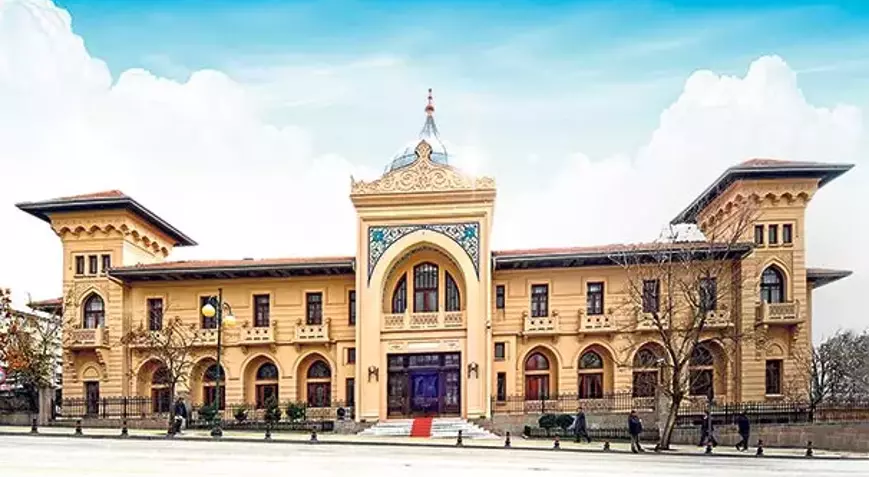
On this meaningful day, I wanted to begin with a meaningful topic:
“Ankara Palas – The Republic’s Architecture of Representation”
With the proclamation of the Republic, Ankara took on a new role: to be the heart of the state.
After the collapse of the Ottoman State and the Grand National Assembly of Türkiye taking over the power to represent the state, Ankara needed a “house of representation” where foreign envoys, artists and thinkers could be hosted.
Atatürk noticed this gap early on. Action was taken on his orders. Many projects were examined:
In Istanbul’s Pera district there were highly successful examples. Hotel d’Angleterre (1841) and Pera Palace (1895) were the pioneers of modern hotel-keeping in the Ottoman era. They offered many innovations at European standards.
These hotels, which he had experienced firsthand, offered their guests the modern lodging privileges of the day, such as hot water and electricity.
The Republic had to carry on this tradition, and swift action was taken.
Yet despite its significance, the building has another interesting story:
Construction of Ankara Palas began in 1924 under Vedat Tek; allegedly, Vedat Bey, unable to collect what he was owed, left the construction half-finished.
Architect Kemalettin Bey then took over the project, and the building was completed according to his design. However, Kemalettin Bey lost his life on the construction site while work was still underway.
The Foundations Administration was able to complete the building in 4 years.
One of the first examples of the Republican-era National Architecture Movement, this work, which brought Seljuk and Ottoman motifs together with a modern European scale, was, when it opened on April 17, 1928, with a capacity of about 120 beds, the best-equipped guesthouse in Europe at the time.
When it opened, Ankara Palas was not just a building; it also hosted many events that symbolized the Republic’s social transformation.
The first events in which women took part in social life on equal terms were held here.
The “Republic Balls” in particular were a rehearsal for how the new Türkiye would present itself. The most sincere and warmest messages to the world were delivered within these walls.
The building served as a hotel/guesthouse until 1975,
Then it was allocated to public institutions,
In 1983 it became the State Guesthouse, and in 2018 it was transferred to the Directorate of National Palaces,
And since 2024, as the Republic Museum, it has been hosting the past.
Ankara Palas is the symbol of a vision that goes beyond architecture. No matter how proud we are of the legacy you left behind, it will never be enough, my Ata.
Sources
- Emre Ozan Aksöz, “Ankara Palas”, Türkiye Turizm Ansiklopedisi, 2019. Open source
- Millî Saraylar İdaresi Başkanlığı, “Ankara Palas”. Open source
- Ahmet Vefa Çobanoğlu ve Özkan Ertuğrul, “Kemâleddin Bey, Mimar”, TDV İslâm Ansiklopedisi, c. 25. Open source
- Gül Nur Demiral, “Mösyö Misiri”, Türkiye Turizm Ansiklopedisi, 2020. Open source
- Wikipedia, “Pera Palace Hotel”. Open source
- Kültür Ansiklopedisi, “Ankara Palas”. Open source
- Anadolu Ajansı (Ensonhaber), “Ankara Palas 97 yaşında”, 17 Nisan 2025. Open source
Sources accessed: 7 October 2026.