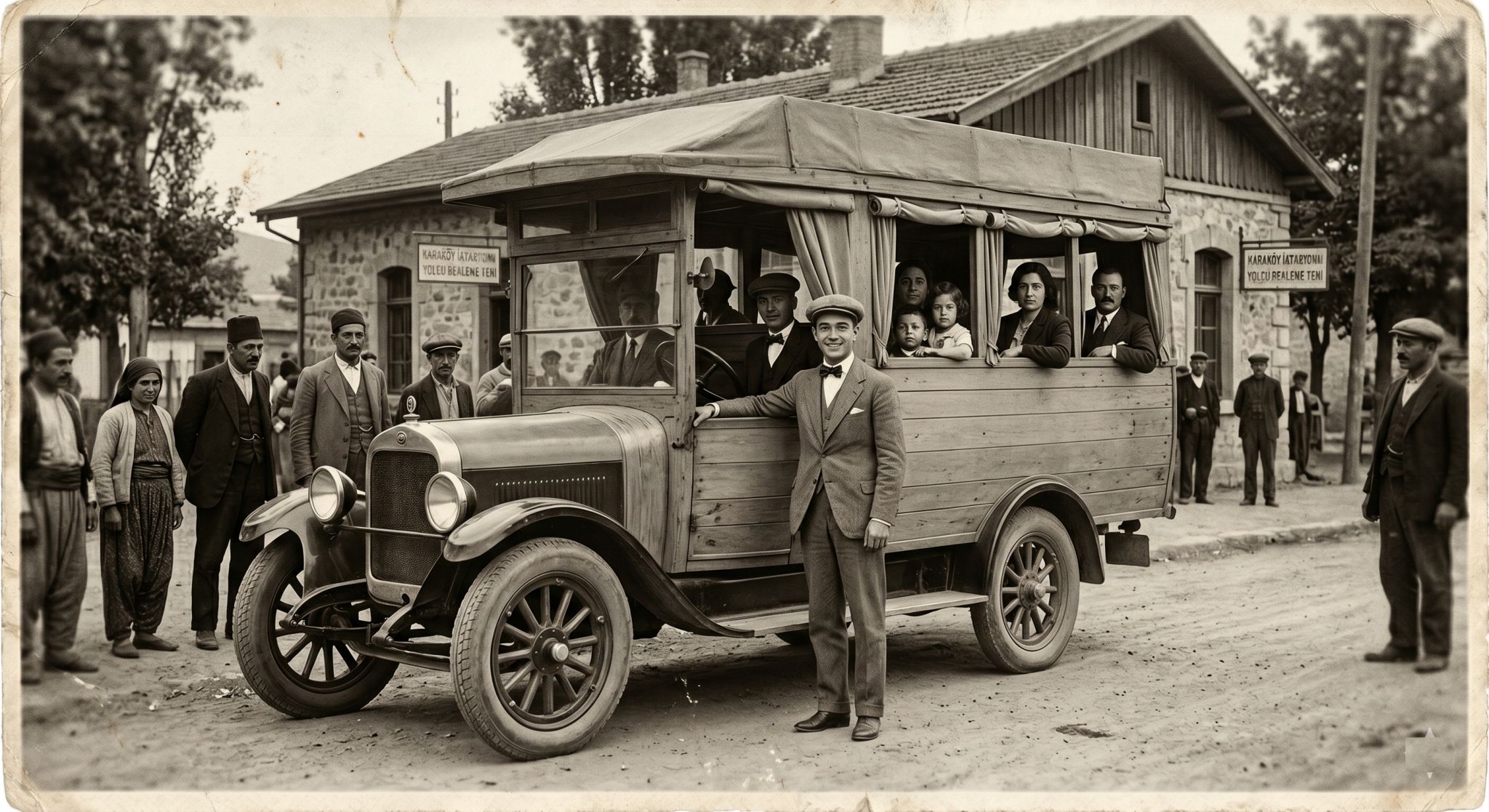
“Kâmil Koç,” founded in 1926
Kâmil Koç’s main business was hauling freight with water buffalo carts, but his life changed after conversations with his commander during his military service. With the idea of modernizing transportation, he took on the entire business model and created the brand we know today.
Bursa, one of Anatolia’s largest centers, had no railway line. To connect to the Baghdad Railway, where the heart of trade was beating, you had to travel from Bursa all the way to Pazaryeri in Bilecik.
Kâmil Koç was the first to spot this gap. He invested his annual farming income in a Fiat truck chassis, had craftsmen in Bursa build a wooden body on top of it, and had it covered with a canvas awning.
First Route: Bursa to the Bilecik/Karaköy Train Station:
This detail is critical. Do you remember the 10th Anniversary March? “We wove the motherland with iron nets from end to end.” In the Türkiye of that era, intercity transportation was built on the railways. In other words, the road infrastructure was inadequate and was laid out mostly for horse-drawn carts. That is why Kâmil Koç, who came up with the idea of turning large-wheeled truck-chassis vehicles into public transport vehicles, became the first company to create road lines feeding the railway.
The fast-growing company had a fleet of 10 buses within two years. The interesting part is that only 3 of the 10 vehicles belonged to Kâmil Koç. The others joined the system through a franchise-like partnership network. We can call it the first “asset-light” model in the road sector. At the time, this both solved the driver problem and brought rapid growth through strong partnerships.
When we look at the history of the transportation sector, the French come first:
The first ticketed transport line was established in Paris in 1662 by Blaise Pascal. The system collapsed because Parliament banned the lower classes from using it.
Stanislas Baudry, who ran a mill in Nantes, opens a bathhouse in 1826 as a side business. Because it is far from the city, he starts a free horse-drawn carriage service to attract customers. But he notices that instead of coming to the bathhouse, passengers get off along the way. Seizing on this opening, Baudry gives up the mill and the bathhouse two years later and turns the service into a commercial line.
Where does the word bus come from?
Next to one of the stops there was a hatter named “Omnès.” His sign read “Omnes Omnibus,” meaning “Omnès for everyone.” People came to associate this wordplay with the bus. Over the centuries, a Latin joke found its way into the dictionaries: “Bus, Autobus, Otobüs”
Kamil Koç was the only national player in the sector from 1926 to 1937.
By opening the Bursa – Ankara route in 1933, it created Türkiye’s first intercity passenger line.
In 1937, Ulusoy entered the scene on a regional scale. It started with an Opel bus on the Of – Trabzon route.
In 1965, with restrictions on vehicle imports, the era of domestic assembly began, and 115 Magirus-Deutz buses were added to the fleet.
In the years that followed, Varan, Pamukkale, Metro and others formed the backbone of Türkiye’s transportation.
But where they all began was a 1926 Fiat truck chassis.
Sources
- Biyografiler.com, “Kâmil Koç kimdir?”. Open source
- Buy From Turkey, “The development of the bus in Turkey”. Open source
- T24, “Kamil Koç satılıyor”. Open source
- Webtekno, “Ulusoy Turizm’i neden artık yollarda göremiyoruz?”. Open source
- Sözcü, “Ulusoy’un otobüsleri satılıyor”. Open source
- Wikipédia (FR), “Carrosses à cinq sols”. Open source
- Wikipédia (FR), “Stanislas Baudry”. Open source
- Wikipedia, “Horse-drawn omnibus”. Open source
- Wikipedia, “Anatolian Railway”. Open source